9.4 Reinstatement of blood donors - Microbiology tests for donors and donations – general specifications for laboratory test procedures
Where a blood donation sample is found to be repeatedly reactive on screening (except for anti-HCMV), the donation and any components must not be released for clinical use. For anti-HBc/anti-HBs exceptions, see chapter 9.2.5. The donor's record must be flagged in accordance with standard operating procedures to prevent the issue of subsequent donations while awaiting the results of confirmatory testing in the reference laboratory.
The screen repeat reactive sample must be sent to a designated reference laboratory for confirmatory testing.
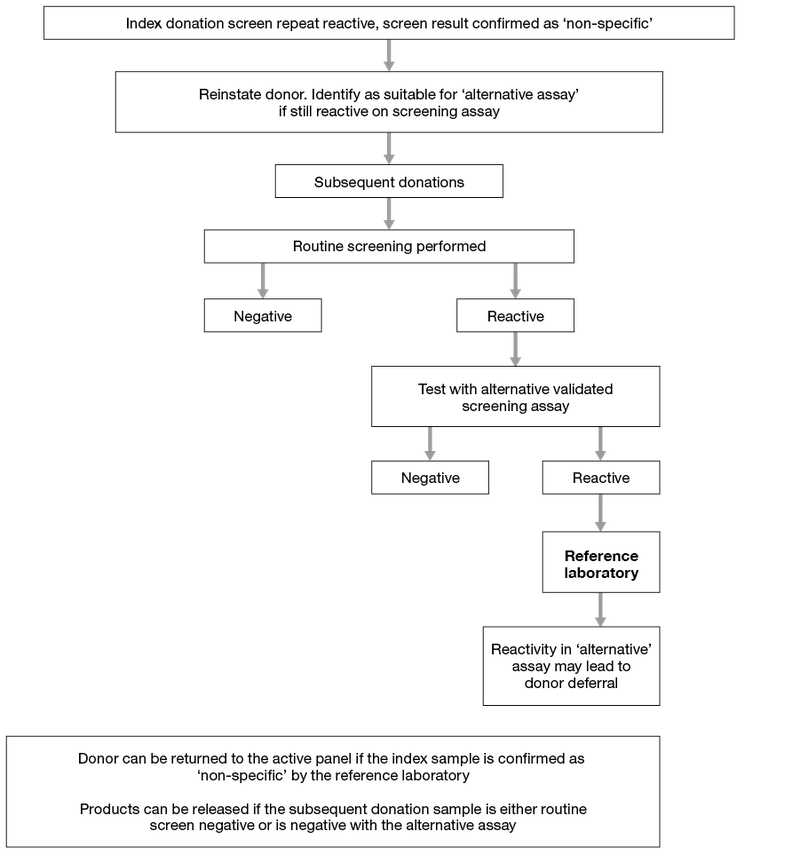
If the donation sample is determined by the reference laboratory to be demonstrating non-specific reactivity, subsequent donations from the donor may be considered suitable for issue provided that the associated donation samples are negative in the primary or an alternative screening assay (Figure 9.5).
Figure 9.5: Action chart - blood donor reinstatement following confirmation of screen reactivity as non-specific
9.4.1: Donors whose samples are confirmed positive
Donors whose blood samples are confirmed positive cannot normally be reinstated, even after successful treatment, as screening test reactivity will persist in serological assays, for example anti-HCV and TPHA.
Blood donations that are anti-HBc positive with an anti-HBs titre greater than 100 IU/L can be accepted, and the donor may continue to donate although this is at the discretion of individual blood services. If these donors are allowed to donate, they must remain HBV DNA negative by ID-NAT at each subsequent donation and their anti-HBs titre must be retested at least every 2 years and remain greater than 100 IU/L.
For tissues and cells, donations that are confirmed as HBsAg negative and anti-HBc positive may be considered suitable for release if a sensitive HBV DNA test (a 95% limit of detection of 20 IU/mL or below) is negative.
Donors with confirmed HEV, HAV or WNV infection should be deferred for 6 months from the date of first detection of HEV,/HAV/WNV RNA. These donors may be reinstated without further testing 6 months from the date of the index RNA positive donation.
If a previously confirmed HEV infected donor is tested prior to the end of the 6-month deferral period and found to be HEV RNA negative on individual testing and HEV IgG positive at ≥1 IU/ml using the PEI International standard for HEV IgG (HEV IgM may or may not still be present), the donor may be reinstated immediately.
Donors with confirmed human B19 DNA should be deferred for 4 weeks from the date of first detection of B19 DNA. These donors may be reinstated without further testing 4 weeks from the date of the index DNA positive donation.
9.4.2: Donors whose samples are repeatedly reactive, but concluded after reference testing to represent non-specific reactivity
Where a blood donation sample is found to be repeatedly reactive on screening, the donation and any components must not be released for clinical use.
The donor's record must be flagged in accordance with standard operating procedures to prevent the issue of subsequent donations while awaiting the results of confirmatory testing in the reference laboratory.
The screen repeat reactive sample must be sent to a designated reference laboratory for confirmatory testing.
If the donation sample is determined by the reference laboratory to be demonstrating non-specific reactivity, subsequent donations from the donor may be considered suitable for issue provided that the associated donation samples are negative in the primary or an alternative screening assay (Figure 9.5).
Blood donations in which reactivity in an anti-HBc screening assay is subsequently confirmed as non-specific do not require any additional screening (unless the donor lapses, has a defined exposure incident or reports a hepatitis-like illness). The confirmed negative result can impart anti-HBc negative 'status' to the donor's record.
9.4.3: Process to reinstate a confirmed non-specific reacting blood donor
A donor with screen reactivity that is confirmed by the reference laboratory as 'non-specific' may be immediately returned to active status with no restrictions on any subsequent donations (see Figure 9.5).
However, in order to reinstate a donor whose sample remains reactive in the original screening assay but confirmed by the reference laboratory to be demonstrating non-specific reactivity, the UKBTS must have the facilities to run appropriate alternative screening assays and to the same standard as primary screening. The following conditions must be met for this to be acceptable:
- The alternative assay must be of equivalent sensitivity to the original screening assay in which the index donation gave a repeatable non-specific reaction and conform to the UK requirements for microbiology screening tests.
- Donations taken subsequent to the return of the donor to the active panel may be used provided that the donation is non-reactive by the alternative assay.
- The donor's record must remain flagged with the information identifying previous non-specific reactivity for the marker.
- For anti-HBc confirmed non-specific reactivity, 'anti-HBc negative' status can be applied. No additional screening is required in subsequent donations unless the donor lapses, has a defined exposure incident or reports a hepatitis-like illness.
Last updated on 19 August 2026