9.2 Microbiology screening - Microbiology tests for donors and donations – general specifications for laboratory test procedures
The guidance presented in this chapter describes the recommended minimum standards for screening of blood, tissues (living and deceased) and stem cells in the UK.
This guidance may be based on UK or Council of Europe guidelines, specifically including:
- European Directorate for the Quality of Medicines and HealthCare (EDQM) Guide to the preparation, use and quality assurance of blood components (known as the ‘Blood Guide’)
- EDQM Guide to quality and safety of tissues and cells for human application (known as the ‘Tissues and Cells Guide’)
- European Union (EU) European Centre for Disease Prevention and Control (ECDC) outputs (e.g. HBsAg)
- a specific instruction from the Department of Health and Social Care (DHSC), including its advisory committees (e.g. HEV)
- an Act of Parliament (e.g. syphilis)
- best practice as approved by the Advisory Committee on the Safety of Blood, Tissues and Organs (SaBTO) and its advisory committees (e.g. selective HTLV screening)
Individual services can choose to test to a higher standard (e.g. individual testing or smaller pool sizes for molecular tests) but must obtain the minimum standards described in:
- Table 9.1 for blood donations
- Table 9.2 for living tissue donations
- Table 9.3 for deceased tissue donations
- Table 9.4 for stem cell and cord blood donations
In general, microbiology screening is carried out on individual donations. However, as nucleic acid testing (NAT) is highly sensitive, it is possible, in certain instances, to screen donations in pools. Where pooled NAT testing is employed, the pool size should be determined by risk assessment, taking into consideration sensitivity of the assay, the endemicity of the infectious agent in the population to be screened, the estimated residual risk and/or any fractionator requirement.
The current maximum validated pool sizes for use for NAT screening in the UK Blood Services are 16 donations for West Nile Virus (WNV), 24 donations for hepatitis B virus (HBV), hepatitis C virus (HCV), hepatitis E virus (HEV) and human immunodeficiency virus (HIV), and 96 donations for hepatitis A virus (HAV) and human parvovirus B19. When applied to microbiology screening, pool sizes must factor in the limit of detection of the specific assay being used. Certain donations that require molecular tests must be tested individually rather than in pools. In these instances, individual NAT (ID-NAT) is specified below. Tables 9.1 to 9.4 state which donations may be screened in pools and which donations have been risk assessed to require ID-NAT.
Although neither are mandatory for blood donations in most of the UK, HIV RNA and HBV DNA are included in nucleic acid screening as the commercial systems available are multiplex assays. If HIV NAT testing is performed, dual-target HIV-1 assays and NAT assays that detect HIV-2 are recommended.
9.2.1: Screening of donations/donors
Donation/donor screening can be broadly divided into two main categories:
- Mandatory - an absolute requirement prior to the release of components. There are, however, different reasons for a specific infectious marker to be defined as 'mandatory' (see above).
- Discretionary - this test must be performed on certain donors/donations if indicated by medical, social or travel history (e.g. WNV).
Additional tests may be recommended by an advisory committee or a professional body but are not a regulatory requirement. Other testing can be optional, where testing is not mandatory but is done at the discretion of individual organisations or establishments. This also applies to situations where a mandatory test is repeated at the discretion of individual organisations or establishments.
The terminology used in this chapter aligns with that described in annex 7, and the meanings of these terms are defined below:
- Mandatory
-
The test is either a regulatory requirement or deemed necessary to ensure regulatory requirements relating to the assessment of donor suitability are met to ensure donor and recipient protection.
- Optional
-
The test is not mandatory and done at the discretion of individual organisations or establishments. This also applies to situations where a mandatory test is repeated at the discretion of individual organisations or establishments.
- Discretionary
-
The test must be performed on certain donors/donations if indicated by medical, social or travel history, or donation history.
- Recommended
-
This test is recommended by an advisory committee or a professional body but is not a regulatory requirement.
- Non-reactive (NR)
-
A sample whose reactivity when first tested falls below the assay cut-off as defined by the manufacturer’s instructions. May also be referred to as a ‘negative’ test result.
- Initial reactive (IR)
-
Any sample whose reactivity when first tested falls above the cut-off as defined by the manufacturer's instructions.
- Repeat reactive (RR)
-
Any sample reactive on 2 or more occasions either in the same screening assay (duplicate), or in 2 or more screening assays that are used in combination sequentially, to determine the suitability of a donation for release for clinical use.
- Alternative screening assay
-
When a second assay for the same screening target, and of similar sensitivity, is used sequentially to screen a sample which is either IR or RR in a first screening assay.
- Confirmatory testing
-
Full investigation, in a designated reference laboratory, of a RR sample to determine whether the reactivity is specific to the infectious agent being screened for and indicative of current or past infection in the donor.
- Positive
-
A sample whose reactivity in confirmatory testing meets pre-defined criteria. This may indicate current or past infection.
- Inconclusive
-
A sample whose reactivity in confirmatory testing is not sufficient and/or specific enough to determine whether it reflects infection or possible non-specific reactivity.
- Negative
-
A sample whose screen reactivity, on investigation, is either not demonstrable or is deemed not to reflect infection.
- Individual nucleic acid test (ID-NAT)
-
Molecular screening of a donation as an individual sample (as opposed to pooled testing).
- Pooled nucleic acid test (NAT)
-
NAT screening can be performed on pooled samples for certain donations. If testing in pools is permitted, the 95% limit of detection should be based on a risk assessment.
- 95% limit of detection (LoD)
-
Lowest concentration at which 95% of positive samples are detected.
Importantly, the mandatory requirements for blood donation and for tissue and stem cell donations are different, with some tests that are defined as ‘discretionary’ for blood donations being ‘mandatory’ for non-blood donations (Tables 9.1 to 9.4).
Although not required for all donations, where additional (discretionary, optional or recommended) screening is required, the results are an integral part of the criteria for the release of that donation/component/product. In addition, for certain donation types, there is the option of quarantine and follow-up serological screening before issue or the inclusion of genomic screening at donation.
For tissues (living and deceased), the EDQM Guide to the quality and safety of tissues and cells for human application indicates that if anti-HBc is 'reactive', an additional determination using a highly sensitive HBV DNA test must be negative and recommends that the most sensitive test available is used. If anti-HBc is positive and HBsAg and HBV-NAT are negative, the donated tissues can be released. As best practice in the UK, individual HBV DNA testing is recommended for all tissues (haemodilution may influence the limit of detection).
Donations and any associated components/products must not be released to stock unless they have been screened and found negative for the mandatory, and any additional, microbiological screening required. In certain circumstances for certain donation/component types, a reactive screen result may not preclude release of the donations/component (see chapter 9.2.5 and chapter 9.4.1).
Where a number is indicated [#] in the table, refer to the explanatory notes below.
| Infectious agent | Marker | Requirement | Format |
|---|---|---|---|
|
HAV |
HAV RNA |
Optional [1] |
Pooled |
|
HBV |
HBsAg |
Mandatory |
Individual |
|
HBV |
HBV DNA |
Recommended |
Pooled |
|
HBV |
anti-HBc |
Discretionary [2] |
Individual |
|
HCMV |
anti-HCMV [3] |
Optional |
Individual |
|
HCV |
anti-HCV |
Mandatory |
Individual |
|
HCV |
HCV RNA |
Mandatory |
Pooled |
|
HEV |
HEV RNA |
Mandatory |
Pooled |
|
HIV |
HIV 1+2 Ag/Ab [4] |
Mandatory |
Individual |
|
HIV |
HIV RNA [4] |
Mandatory/ |
Pooled |
|
HTLV |
anti-HTLV I/II |
Discretionary [6] |
Individual |
|
Human B19 |
B19 DNA |
Optional [1] |
Pooled |
|
Plasmodium sp. |
anti-P. falciparum/vivax |
Discretionary |
Individual |
|
Syphilis |
anti-treponemal |
Mandatory |
Individual |
|
Trypanosoma cruzi |
anti-T. cruzi |
Discretionary |
Individual |
|
WNV |
WNV RNA |
Discretionary |
Pooled |
Notes on Table 9.1
- Required for plasma collected for the production of plasma-derived medicinal products.
- As a minimum, all blood donors are to be screened for anti-HBc at their first donation or their first donation after the introduction of anti-HBc screening. anti-HBc screening to be repeated if a donor lapses (over 2 years) or has a new HBV risk.
- Ideally both IgG and IgM, but IgG alone is considered sufficient.
- In addition to HIV-1 groups M and N, HIV-1 assays should also detect HIV group O.
- HIV RNA is mandatory within Scotland.
- As a minimum, all blood donors are to be screened for anti-HTLV at their first donation or their first donation after the introduction of anti-HTLV screening or if the blood donation is destined for use to prepare non-leucodepleted products. anti-HTLV screening to be repeated if a donor has a new HTLV risk.
Where a number is indicated [#] in the table, refer to the explanatory notes below.
| Infectious agent | Marker | Requirement | Format |
|---|---|---|---|
|
HBV |
HBsAg |
Mandatory |
Individual |
|
HBV |
anti-HBc [1] |
Mandatory |
Individual |
|
HBV |
HBV DNA |
Recommended [2] |
Individual |
|
HCV |
anti-HCV |
Mandatory |
Individual |
|
HCV |
HCV Ag and/or |
Optional |
Individual |
|
HCV |
HCV RNA |
Recommended [2] |
Individual |
|
HEV |
HEV RNA |
Optional [3] |
Pooled [4] |
|
HIV |
HIV 1+2 Ag/Ab [5] |
Mandatory |
Individual |
|
HIV |
HIV RNA [5] |
Recommended [2] |
Individual |
|
HTLV |
anti-HTLV I/II |
Discretionary [6] |
Individual |
|
Plasmodium sp. |
anti-P. falciparum/vivax |
Discretionary |
Individual |
|
Plasmodium sp. |
Plasmodium spp. DNA [7] |
Optional |
Individual |
|
Syphilis |
anti-treponemal |
Mandatory |
Individual |
|
Trypanosoma cruzi |
anti-T. cruzi |
Discretionary |
Individual |
|
WNV |
WNV RNA |
Discretionary |
Pooled [4] |
Notes on Table 9.2
- anti-HBc reactive tissue donations can be considered suitable for release if both HBsAg and individual HBV DNA are negative (this can be a multiplex ID-NAT).
- NAT testing is not mandatory for living tissue donors, however if not done on the donation sample, the tissue must be quarantined for at least 180 days and a further sample taken for serological testing before it can be released. If the quarantine option is not utilised, due to the recommendation for individual HBV DNA testing and due to the triplex nature of commercial NAT assays, all tissues will undergo ID-NAT (for HBV, HCV and HIV).
- HEV RNA testing is not mandatory for living tissue donations (no specific identifiable risk).
- Samples from living tissue donors may be pooled for HEV RNA testing (current maximum pool size is 24 samples) and WNV RNA testing (current maximum pool size is 16 donations).
- In addition to HIV-1 groups M and N, HIV-1 assays should also detect HIV group O.
- HTLV testing is not mandatory for all living tissue donors but is for donors living in or originating from high-prevalence areas, or with sexual partners originating from those areas, or where the donor’s parents originate from those areas. In practice, all tissue donations are tested for anti-HTLV I/II.
- For acceptance of anti-malaria positive tissue donations, see Malaria in the Tissue (Live Donors) Donor Selection Guidelines (TL-DSG).
Where a number is indicated [#] in the table, refer to the explanatory notes below.
| Infectious agent | Marker | Requirement | Format |
|---|---|---|---|
|
HBV |
HBsAg |
Mandatory |
Individual |
|
HBV |
anti-HBc [1] |
Mandatory |
Individual |
|
HBV |
HBV DNA |
Mandatory |
Individual |
|
HCV |
anti-HCV |
Mandatory |
Individual |
|
HCV |
HCV Ag and/or |
Optional |
Individual |
|
HCV |
HCV RNA |
Mandatory |
Individual |
|
HEV |
HEV RNA |
Optional [2] |
Individual [3] |
|
HIV |
HIV 1+2 Ag/Ab [4] |
Mandatory |
Individual |
|
HIV |
HIV RNA [4] |
Mandatory |
Individual |
|
HTLV |
anti-HTLV I/II |
Discretionary [5] |
Individual |
|
Plasmodium sp. |
anti-P. falciparum/vivax |
Discretionary |
Individual |
|
Plasmodium sp. |
Plasmodium spp. DNA [6] |
Optional |
Individual |
|
Syphilis |
anti-treponemal |
Mandatory |
Individual |
|
Trypanosoma cruzi |
anti-T. cruzi |
Discretionary |
Individual |
|
WNV |
WNV RNA |
Discretionary |
Individual [3] |
Notes on Table 9.3
- anti-HBc reactive tissue donations can be considered suitable for release if both HBsAg and individual HBV DNA are negative (this can be a multiplex ID-NAT).
- HEV RNA testing is not mandatory for deceased tissue donations (no specific identifiable risk).
- Samples from deceased tissue donors, if taken ante-mortem before circulatory arrest, may be pooled for HEV RNA testing (current maximum pool size is 24 samples) and WNV RNA testing (current maximum pool size is 16 donations).
- In addition to HIV-1 groups M and N, HIV-1 assays should also detect HIV group O. Dual-target HIV-1 assays and NAT assays that detect HIV-2 are recommended.
- HTLV testing is not mandatory for deceased tissue donors but is for donors living in or originating from high-prevalence areas, or with sexual partners originating from those areas, or where the donor’s parents originate from those areas. In practice, all tissue donations are tested for anti-HTLV I/II.
- For acceptance of anti-malaria positive tissue donations, see Malaria in the Tissue (Deceased Donors) Donor Selection Guidelines (TD-DSG).
Where a number is indicated [#] in the table, refer to the explanatory notes below.
| Infectious agent [1] | Marker | Requirement | Format |
|---|---|---|---|
|
EBV |
anti-EBV [2] |
Recommended/ |
Individual |
|
HBV |
HBsAg |
Mandatory |
Individual |
|
HBV |
anti-HBc [3] |
Mandatory |
Individual |
|
HBV |
HBV DNA |
Recommended [4] |
Pooled |
|
HCMV |
anti-HCMV [5] |
Recommended/ |
Individual |
|
HCV |
anti-HCV |
Mandatory |
Individual |
|
HCV |
HCV RNA |
Recommended [4] |
Pooled |
|
HEV |
HEV RNA |
Discretionary |
Pooled |
|
HIV |
HIV 1+2 Ag/Ab [6] |
Mandatory |
Individual |
|
HIV |
HIV RNA [6] |
Recommended [4] |
Pooled |
|
HTLV |
anti-HTLV I/II |
Discretionary [7] |
Individual |
|
Plasmodium sp. |
anti-P. falciparum/vivax |
Discretionary |
Individual |
|
Plasmodium sp. |
Plasmodium spp. DNA [8] |
Optional |
Individual |
|
Syphilis |
anti-treponemal |
Mandatory |
Individual |
|
Toxoplasma gondii |
anti-T. gondii IgG/IgM [9] |
Recommended/ |
Pooled |
|
Trypanosoma cruzi |
anti-T. cruzi |
Discretionary |
Individual |
|
WNV |
WNV RNA |
Discretionary |
Pooled |
Notes on Table 9.4
- Other testing (e.g. EBV, toxoplasmosis) may be required depending upon specific additional risk and/or special requests for individual recipients. For certain product types that are exported, there may be additional end user screening requirements.
- See annex 7.
- anti-HBc reactive cell donations can be considered suitable for release if both HBsAg and HBV DNA by individual HBV NAT are negative.
- NAT testing for HBV, HCV and HIV is not mandatory for stem cell donations but replaces the need for quarantine and follow-up serological screening.
- Ideally both IgG and IgM, but IgG alone is considered sufficient – see annex 7.
- In addition to HIV-1 groups M and N, HIV-1 assays should also detect HIV group O.
- HTLV testing is not mandatory for all cell donations but is for donors living in or originating from high-prevalence areas, or with sexual partners originating from those areas, or where the donor’s parents originate from those areas. However, in practice, all cell donations are tested for anti-HTLV I/II.
- For acceptance of anti-malaria positive donations, see Malaria in the Bone Marrow and Peripheral Blood Stem Cell Donor Selection Guidelines (BM-DSG) and Malaria in the Cord Blood Donor Selection Guidelines (CB-DSG).
- anti-T. gondii IgG and IgM should be testing for in the setting of allogeneic HPC and TC donation – see annex 7.
9.2.2: Deceased neonatal and infant tissue donors
Full microbiology screening of a maternal sample is always required.
For still births and for neonates up to 28 days after birth, no microbiology screening of the neonate is required.
For infants more than 28 days after birth, full microbiology screening of an infant’s sample is required.
9.2.3: Serology screening algorithms
9.2.3.1: Blood donations
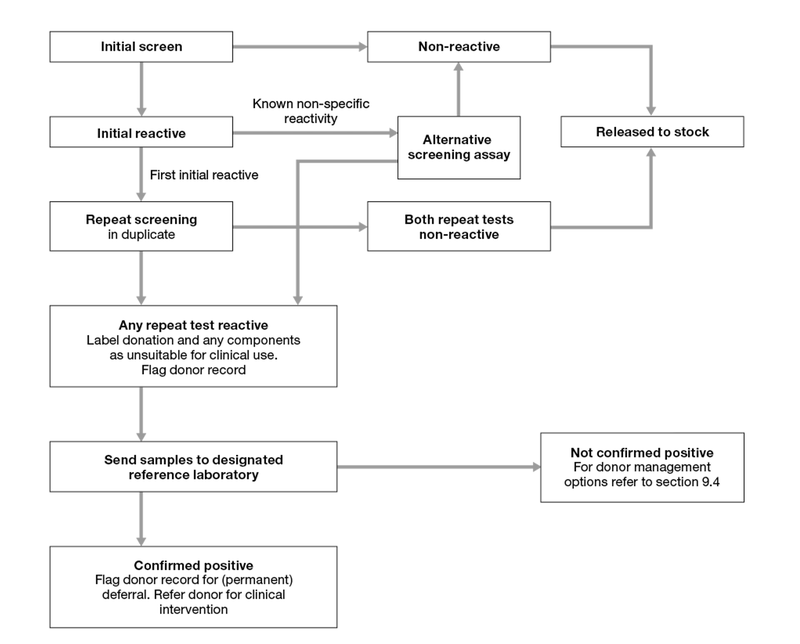
No donation which is initially reactive for the first time in the routine screening assay can be released for clinical use unless subsequently shown to have a negative result in both tests in duplicate repeat testing using the same assay.
Blood donations which are reactive in 1 or both of the repeat tests are unsuitable for use and must be labelled as biological hazard/not for transfusion.
Donations which are initially reactive in the routine screening assay, but which originate from donors who have been previously investigated in a reference laboratory, and have been shown to be demonstrating non-specific reactivity, may be screened using a second (alternative) screening assay of at least equal sensitivity to the primary screening assay, and can be considered suitable for clinical use if giving a negative result in the alternative screening assay.
A flowchart for screening of blood donations is provided as Figure 9.1.
Figure 9.1: Serology screening – blood donations
9.2.3.2: Tissue and stem cell donations
All initially reactive samples (see Figure 9.2) must be re-tested in duplicate using either the same assay or using an alternative assay that has been specifically evaluated to have at least equal sensitivity and ideally is based on different antigens and/or antibodies and/or principles.
Donations that are non-reactive in both of the repeat tests can be considered suitable for clinical use.
Donations that are reactive in 1 or both of the repeat tests may in some clinical circumstances, and depending on the confirmatory results, be considered suitable for use [SaBTO Microbiological safety guidelines].
Figure 9.2: Serology screening – tissue and cell donors/donations
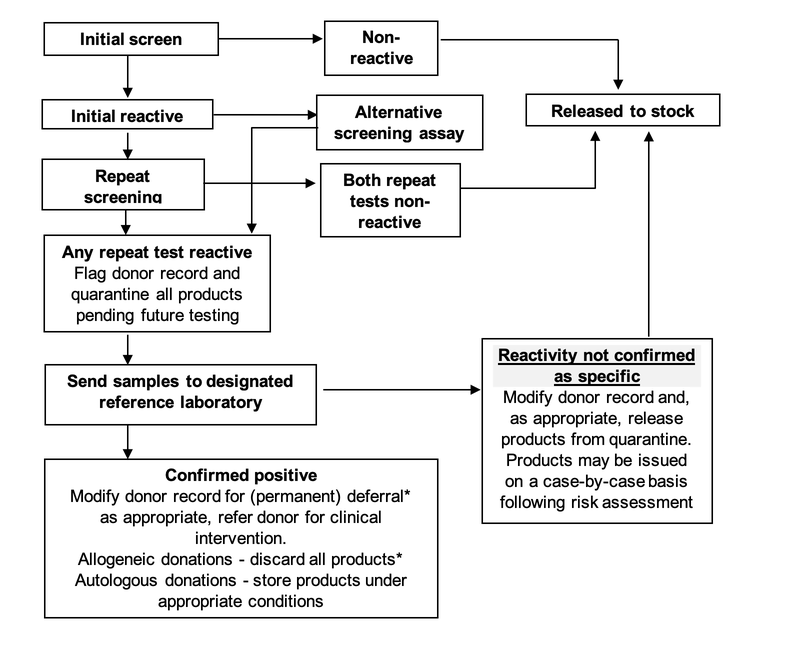
* Tissue/stem cell donors/donations confirmed to be anti-HBc reactive, and which are HBsAg and ID HBV DNA negative may be considered suitable for release
9.2.4: Molecular screening algorithm
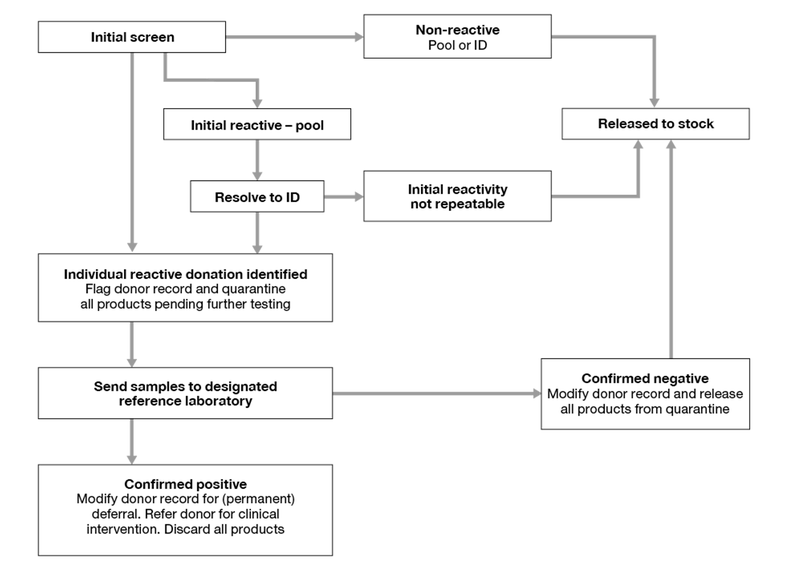
All initially reactive pools (see Figure 9.3 and Figure 9.4) must be resolved to an individual (or more) reactive donation(s). All other non-reactive donations can be considered suitable for clinical use.
Individual reactive donations are unsuitable for clinical use and must be labelled as biological hazard/not for transfusion.
Stem cell donations from known infected individuals that are reactive on screening may in some clinical circumstances be considered suitable for use [SaBTO Microbiological safety guidelines].
Figure 9.3: Molecular screening – blood donations
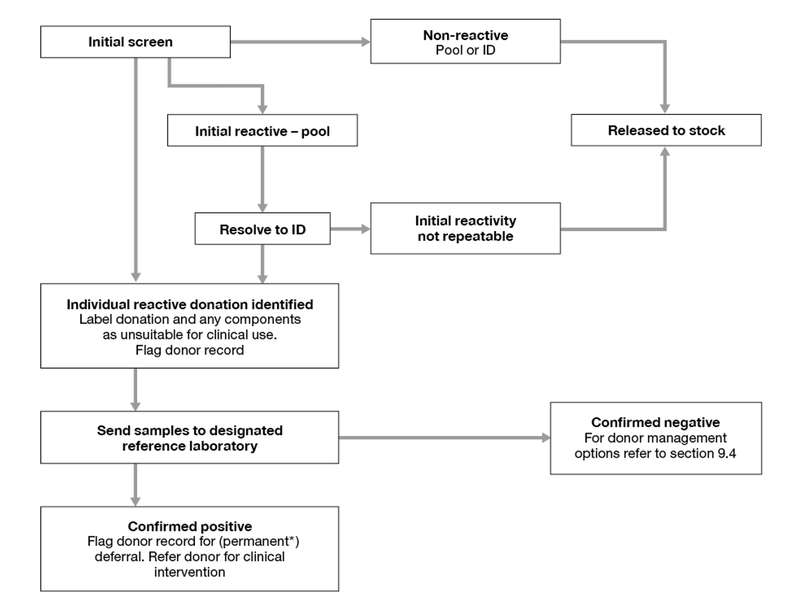
* Donors confirmed to be HEV or WNV RNA positive need only be deferred for 6 months from initial detection.
Figure 9.4: Molecular screening – tissue and cell donors/donations
9.2.5: Confirmatory testing
When a donation is screen reactive for any of the serological or molecular mandatory or additional microbiology tests described above (except for anti-HCMV) samples from the donor/donation must undergo confirmatory testing at a designated reference laboratory.
Blood donations that are anti-HBc positive with an anti-HBs titre greater than 100 IU/L can be accepted, and the donor may continue to donate although this is at the discretion of individual blood services. If these donors are allowed to donate, they must remain HBV DNA negative by ID-NAT at each subsequent donation and their anti-HBs titre must be retested at least every 2 years and remain greater than 100 IU/L.
For tissues and cells, donations that are HBsAg negative and anti-HBc positive may be considered suitable for release if a sensitive HBV DNA test (a 95% LoD of 20 IU/mL or below) is negative.
anti-T. gondii IgG and IgM screening is recommended for HSC, donor lymphocyte infusions and other therapeutic cells (e.g. selected and cultured products including T-cells, natural killer cells, mesenchymal stem cells, cytotoxic T-lymphocytes, T-regulatory cells, tumour derived cells) and embryonic stem cell lines intended for clinical use derived from human embryos initially created for fertility treatment with the use of IgM positive donors avoided. Confirmation of anti-T. gondii IgM only reactivity is recommended due to known specificity issues with IgM assays.
If HEV, HAV or WNV RNA is confirmed in a donor, the donor record must be flagged as 'temporary exclusion' for 6 months. The donor can be reinstated automatically at least 6 months after the date of the index HEV, HAV or WNV RNA positive donation (see chapter 9.4).
If human B19 DNA is confirmed in a donor, the donor record must be flagged as 'temporary exclusion' for 4 weeks. The donor can be reinstated automatically at least 4 weeks after the date of the index DNA positive donation (see chapter 9.4).
In all other cases, the donor record must be flagged as 'permanent exclusion risk - not to be used for clinical use' or equivalent.
In all cases where a positive result is confirmed, arrangements should be made to inform the donor and to ensure that the donor is given appropriate advice.
Please note, autologous stem cell donations may be collected from individuals who are known to be infected with one or more of the infectious agents for which donations are routinely screened. Such individuals are not generally classified as donors for the purposes of these guidelines.
If a negative, inconclusive or indeterminate result is reported following confirmatory testing, and the initial reactivity is determined by the reference laboratory to be non-specific, use of further donations or the same donation (tissue and stem cell donors only) may be possible, as covered in chapter 9.4.
9.2.5.1: Specific requirements for HBsAg confirmation
The designated reference laboratory should, when appropriate, perform specific neutralisation tests for HBsAg to ensure that donors with low-level HBsAg reactivity, in the absence of other HBV markers, are not incorrectly reported as non-specifically reactive.
Last updated on 19 August 2026