Peru - Geographical disease risk index
- Malaria
-
Risk Category B
Risk Category explanation
A: countries where the malarial risk is present in the whole country all year or with very clear seasonal guidance.
B: countries where only parts of the country are affected.
C: countries where malaria is limited to discrete pockets, where the risk of infection is low, or where there are few visitors to affected areas. It is likely that tourists who visit these countries will be able to donate but individual assessment must be applied. Donors are likely to have detailed knowledge if they have visited any malarial areas. The healthcare professional should establish whether the donor sought advice prior to travel and if they were advised to take antimalarial precautions.
Malaria is present in the country east of the Andes below 2000 metres.
There is virtually no risk above this altitude in the Andes. No risk to the west of the Andes along the Pacific coast (except in the extreme northern coastal area).
Travellers to Lima, the Inca trail routes taken by trekkers to Cuzco City, Machu Picchu, and Lake Titicaca, accept.
Previous Malaria risk:
- Until February 1996:
All year in whole country. - Until September 2006:
All year in rural areas below 1500 metres.
- Until February 1996:
- Trypanosoma Cruzi
-
Risk
- West Nile Virus
-
No Risk
- Viral haemorrhagic fever
-
No Risk
- Mosquito-borne viruses
-
Risk
- Chikungunya Virus
- Dengue Virus
- Yellow Fever Virus
- Zika Virus
Risk applies all year in whole country.
Malaria Map
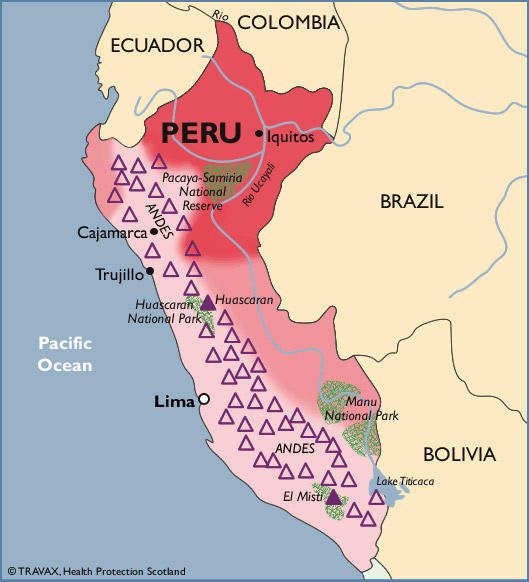
Using the map
This map is only intended as a guide and must always be used in conjunction with the Malaria guidance text above. Sourced from Travax and TravelHealthPro. Please note, the map above may differ from the source version, which may have been updated since publication here.
- Reason for change:
- 'Tropical viruses' renamed 'Mosquito-borne viruses'
- Version:
- Mosquito-borne viruses
- Version details:
GDRI Edition 002 Release 57 (11 August 2026)